
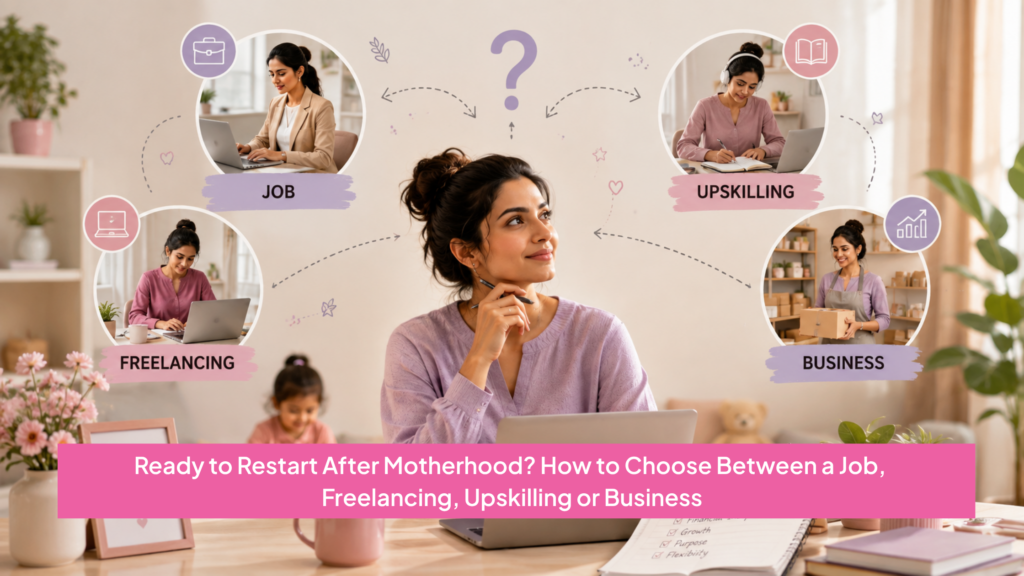
Deciding to restart after motherhood can feel exciting. It can also bring a brand-new kind of uncertainty.
You might know you want to learn, earn, or rebuild your professional identity, and still have no idea which direction to take. Go back to a job? Try freelancing? Update your skills first? Start a business?
There’s no single answer that works for every mother. A meaningful career restart after motherhood starts with picking a path that actually fits your present life, not whatever looks impressive or successful for somebody else.
How can you restart your career after motherhood?
Start by taking stock: your experience, the time you have, your financial priorities, your family responsibilities, your support system. Then weigh your options against how much flexibility, stability, preparation and investment each one demands. You don’t have to lock in your entire future today. You just need to spot the most realistic direction for your next stage.
What should you consider before choosing a restart path?
Before you even look at specific options, get honest about where you currently stand.
Ask yourself:
How many hours can I consistently give each week?
Can I hold off on income while I focus on learning, or do I need money coming in now?
What qualifications, experience and transferable skills do I already have?
How much flexibility do I actually need?
What family or childcare support can I count on?
Am I okay with an uncertain income for a while?
Do I need to rebuild my confidence gradually, or am I ready to jump in?
Your answers give you a practical foundation for choosing between a job, freelancing, upskilling or business.
The right path isn’t necessarily the most ambitious one. It’s the one you can actually start, and keep going.
Is returning to a job the right option for you?
Going back to employment might suit you if you want predictable income, a defined role, and a structured professional environment.
A job can rebuild your workplace exposure, put you back on a team, and keep you on an established career path. It often comes with benefits and steadier income than independent work too.
Before applying, think through:
Work timings and flexibility
Commute or remote-work options
Childcare arrangements
What’s changed in your industry during your break
Skills that might need a refresh
The kind of role and responsibility you’re genuinely ready to manage
Don’t assume you have to return at the same level or in the exact same field. A bridge role, part-time position, returnship, or related role can offer a far more manageable starting point.
Does freelancing make sense for mothers restarting their careers?
Freelancing gives you more control over your workload and hours. It can work well if you have a marketable skill: writing, designing, teaching, bookkeeping, consulting, digital marketing, tech support, and so on.
That said, freelancing for moms isn’t automatically easy, and it definitely isn’t fully flexible from day one. Beyond delivering the actual work, you’ll need to find clients, put together proposals, communicate professionally, hit deadlines, and chase down payments.
Freelancing tends to work as a starting option when you:
Can clearly define the service you’re offering
Have a few consistent hours to work with
Are willing to build a portfolio
Can handle workload and income that fluctuate
Want to ease into it through smaller projects first
Start with one specific service and one sample project. You don’t need a full business setup just to test whether people actually need, and will pay for, your skill.
Should you upskill before returning to work?
Upskilling makes sense when your existing knowledge needs a refresh, or when you want to move into a different field altogether.
Effective upskilling for mothers should point toward something specific. Before you sign up for a course, ask yourself what role, freelance service, or opportunity that skill is actually going to unlock.
Skip the habit of collecting certificates without applying anything you learn. Pick one relevant skill, complete a manageable learning programme, and build a small project that proves what you can now do.
Learning a digital tool, for instance, becomes far more valuable once you use it to build a portfolio sample. Updating your subject knowledge matters more when it’s aimed at a specific role or service.
Learning should give you direction. It shouldn’t become just another way of putting off your restart.
Is starting a business the best path after motherhood?
Got a strong skill? A clear problem customers actually have? An idea people are already asking for? Then starting a business might be worth a look.
Yes, it can bring independence and long-term growth. It also comes with real uncertainty: finding customers, taking on financial responsibility, showing up day after day whether you feel like it or not. The flexibility usually improves eventually, but that early stretch demands a lot.
Before you invest heavily, validate the idea first:
Who’s the customer, specifically?
What exact problem are you solving?
Are people already searching for this kind of solution?
Can you start with a smaller version of it?
What time and money will it actually require?
Can you test demand before you build the whole thing?
Not every interest has to turn into a business. Start by talking to potential customers, or running a limited pilot. Real evidence from the market beats encouragement every time.
Which career option is best after a career break?
The best option depends entirely on what you need right now.
Want stable income and professional structure? Honestly, a job’s probably your best bet. More interested in flexibility, earning a bit at a time? Freelancing usually works out better there. Mostly just want to brush up on skills or pivot into something new? Start with upskilling. And if independence and building something of your own is what’s pulling you, business is the natural entry point.
These are just starting points, though. A combination often works better. You might upskill before applying for jobs, freelance while you prepare for employment, or test a business idea alongside another source of income.
How can you make the final decision?
Try this simple decision filter:
What result do I want within the next six months?
How much time can I contribute, consistently?
Which skills and experience can I put to use right away?
What preparation does my preferred option actually require?
How much financial uncertainty can I realistically handle?
What support will I need to keep going?
Choose whatever fits your answers most closely. Then pick one action you can complete within the next seven days.
That could be updating your résumé, researching roles that fit, putting together a freelance sample, picking a focused course, or having a real conversation with a potential customer about your idea.
Choose a starting direction, not a permanent identity
Your first choice doesn’t have to define your entire future.
A mother can return to a job and later become a freelancer. She can upskill before starting a business, or freelance before deciding whether employment actually suits her better. Careers evolve as confidence, responsibilities and opportunities shift.
A successful return to work after motherhood isn’t about getting the decision perfectly right on the first try. It’s about choosing a realistic direction, taking one meaningful first step, and learning as you go.
Join the FabMom Space Journey
Not sure which direction fits your present life?
Join FabMom Space to reflect on your experience, available time, priorities and family responsibilities, and discover a practical next path toward learning, work, freelancing or business.
[Join FabMom Space]